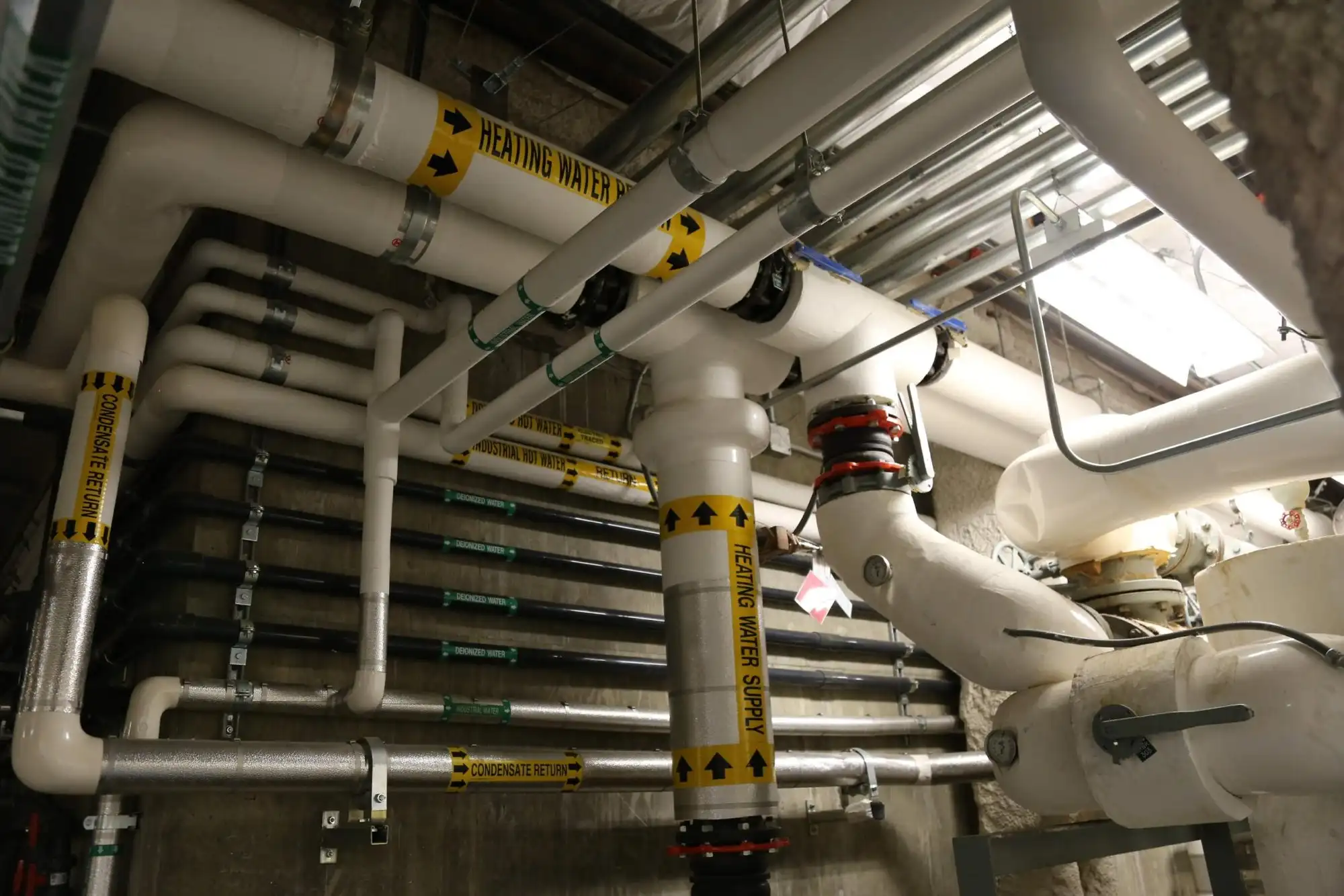
Plenty of HVAC companies will not touch a boiler. We will — hydronic heating is a large part of what this crew came out of commercial work already knowing, and it is the reason a lot of people end up calling us.
AT A GLANCE
- Do you work on boilers
- Yes — service, repair, replacement and radiant
- Boiler lifespan
- 15 to 30 years depending on type and water treatment
- What decides that range
- Water chemistry and air elimination, more than the brand
- Radiant response time
- Hours, not minutes. It is designed for steady state.
- Forced air instead?
- That is a furnace — see Furnace Service & Replacement
We work on boilers
Worth saying first, because it is the question that brings most people to this page. A large share of heating companies across the south metro do forced air and nothing else, and a boiler call gets declined or handed off. Ours does not.
Hydronic heating — boilers, radiant floors, baseboard, zoned loops — is ordinary work here. Commercial and institutional mechanical systems are overwhelmingly hydronic, so this is the equipment the crew spent years around before ever setting foot in a house.
Distribution is usually the problem
When somebody calls about heating, the complaint is nearly always comfort rather than failure. The system runs. It just does not produce a house that is the same temperature in every room people use.
That is almost never solved by more capacity. Turning up the thermostat to warm one cold bedroom means overheating the rest of the house, running the equipment harder, and paying for both. The actual answer is measuring where the heat is going, and then balancing.
On a hydronic system that means balancing the flow across zones and getting the air out of the loops, because a single air pocket will stop a loop from delivering heat regardless of how hard the boiler works. On a forced-air system it means duct sizing and routing, dampers, and measuring airflow at registers rather than holding a hand in front of them.
Hydronic systems and the water in them
Boilers and radiant systems are closed loops, and the thing that determines whether they last fifteen years or thirty is what is in the water. Oxygen is the enemy: it enters through makeup water, through non-barrier tubing, or through a leak, and it corrodes steel components from the inside where nobody looks.
So a properly built hydronic system has functioning air elimination, correct expansion capacity, and pressure that is actually set rather than whatever it drifted to. Those are unglamorous items that get skipped on installation and never get checked afterwards.
Zoning is where the value usually is
If you have rooms that never match each other, adding zones is generally the higher-value improvement — more so than replacing a boiler that is still working. On a hydronic system it is usually straightforward, because the loops are already separate paths and what is missing is the control over them.
Radiant is worth understanding on its own terms before anyone specifies it. It heats the mass of the floor, which then radiates steadily, so it produces very even comfort and holds a set temperature extremely well. What it does not do is respond quickly. Deep overnight setbacks work against it rather than saving money.
COMMON QUESTIONS
Do you work on boilers?
Yes. Allen & Sons services, repairs and replaces boilers, and installs and balances radiant floor and hydronic systems. This is worth stating plainly because a lot of heating companies in the south metro do forced air only and will decline a boiler call, which is how people end up phoning four places. Commercial mechanical work is largely hydronic, so it is familiar ground for this crew rather than an exception.
Why is one room always cold?
Almost always distribution rather than a failing boiler. On a hydronic system it is usually a zone that has never been balanced, or an air pocket sitting in a loop and stopping flow. On forced air it is ductwork, a closed damper or a long run to a far room. Either way the fix is measurement across the whole system rather than turning the thermostat up and heating every other room past comfort.
How long does radiant floor heat take to warm up?
Hours, and that is by design rather than a fault. Radiant heats the mass of the floor, which then radiates steadily. It produces very even, comfortable heat and is excellent at holding a set temperature, but it is poor at responding quickly to changes. Setting it back deeply at night and expecting a fast recovery in the morning works against how it functions.
How long should a boiler last?
Fifteen to thirty years, with a wide range depending on the type of boiler and, above all, on water treatment. Hydronic systems are closed loops, and what determines their life is whether the water in them is chemically managed and whether air is being properly eliminated. Oxygen in a hydronic loop corrodes the system from the inside.
Can I add zones to my existing system?
Often yes, and it is one of the higher-value improvements available if you have rooms that never match each other. On hydronic it is generally straightforward. On forced air it depends on whether the existing ductwork can be sensibly divided, which is a question we answer by looking at the actual duct layout rather than assuming.